When reason and the pursuit of pleasure invite the invisible into the realm of dialectics
.
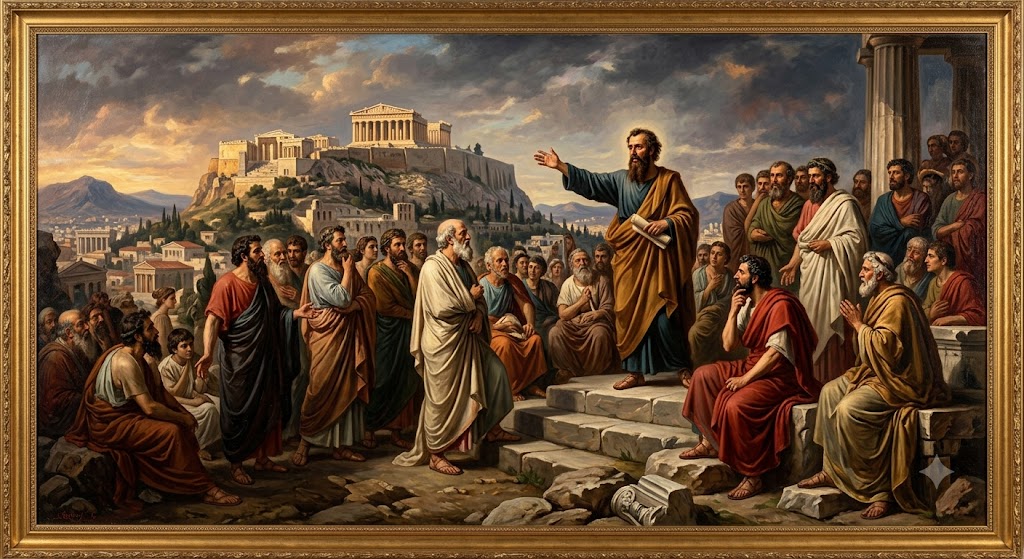
Chapter 17 of Acts, in the New Testament, recounts Paul’s visit to the city of Athens between approximately 50 and 52 AD. And what was Athens like at that time? The schools founded by Plato and Aristotle remained active, and the dominant philosophical currents were Stoicism and Epicureanism. Indeed, the city was filled with temples, altars, and statues of gods. Paul’s spirit was deeply troubled—as was his speech when he addressed the public squares. A group of Epicurean and Stoic philosophers began to debate with him. Some asked, “What is this babbler trying to say?” Others remarked, “It seems he is preaching foreign gods” (Acts 17:18). They said this because Paul was preaching the good news about Jesus and the resurrection.
But what, after all, was the Areopagus, and what philosophical thought dominated the era?
The Areopagus: The name means “Hill of Ares” (the god of war). Ares represented the physical, violent, brutal, and chaotic side of war. Mars (Roman mythology) represented military power, discipline, stability, and Rome’s expansion. Since Athens was under the rule of the Roman Empire in 50 AD, the corresponding figure—and the one far more venerated by the rulers of the time—was Mars, the Roman equivalent.
Meanwhile, the cultural landscape of Athens was largely dominated by two rival schools of thought: Stoicism and Epicureanism.
Stoicism: Founded by Zeno of Citium, Stoicism was the most popular philosophy among the Roman elites and rulers of the time. They believed the cosmos was governed by a divine, impersonal reason (the Logos). Everything in the universe was interconnected. Epicureanism: founded by Epicurus, it represented the direct opposite of Stoicism in almost every respect. Its adherents were materialists and atomists. They believed the world was composed of atoms and the void, created by chance, without divine purpose or destiny.
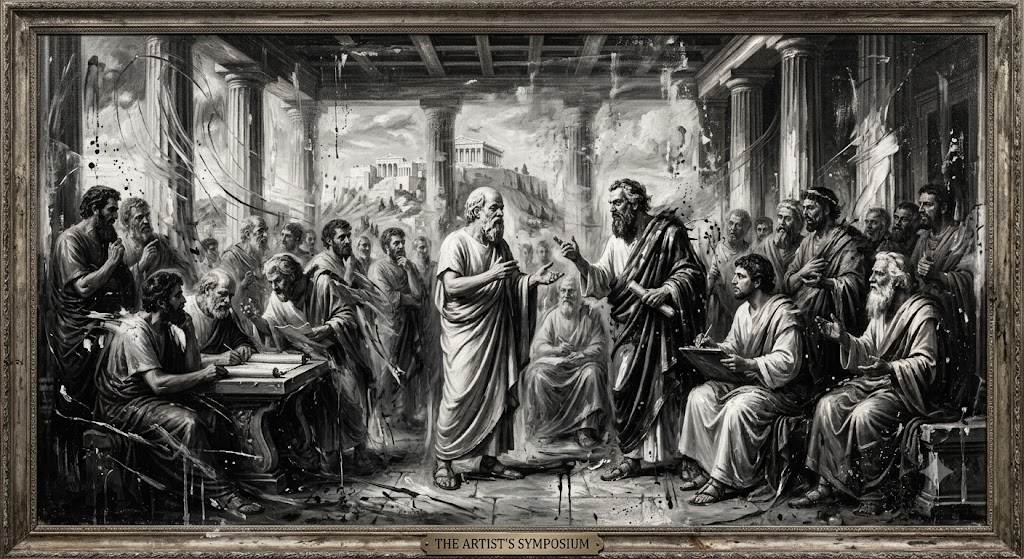
In antiquity, dialectics was understood as the art of dialogue, logic, and argumentation. The Stoics: Masters of Dialectics They used dialectics as an essential tool to train the mind, detect fallacies, defend their doctrines, and prove that the universe was governed by reason (Logos). The Epicureans: Experience over Dialectics Instead of pure logic, they developed "Canonics," a theory of knowledge based on sensory perception. For them, truth derived from what could be seen and felt. Paul’s dialectics employed dialogue as a tool for theological persuasion and conversion; it operated based on the logic of divine revelation. The Christian worldview of Paul of Tarsus was grounded in the centrality of the risen Jesus Christ as the turning point of all human history. For Paul, reality was explained not by eternal cycles (as the Greeks believed) or by chance (as the Epicureans did), but by a linear narrative of creation, the Fall, and divine redemption.
Paul's Dialectic....When Paul observed Athens, he perceived, amidst the statues of gods, an unknown god, an anomaly in the midst of idolatry, full of forms and characteristics, in which myth sustained all those beliefs and rituals like a pillar. Paul, more than likely, perhaps perceived that this unknown god would be a way to present the "new doctrine" with diplomacy, deconstruction, and a final ultimatum.Paul identified the mythos and announced the logos, what God wanted the Athenians to worship without knowing. This was all that the intellectual elite thought they knew. The God who made the world and everything in it. (Acts 17:24, cosmology). In the midst of his bold discourse, he says that this god does not need to be served by human hands, as if he needed anything, and is the god who gives life to all, ontology, the origin of being.By citing Epidemius and Aratus of Seles, Paul deconstructs something already known to the Athenian elite. He compares gold, silver, or even stone to mere imaginings or even the daydreams of a man. Immediately afterward, he states that God does not take into account times of ignorance, and further warns them to repent.
The Unknown God
In the beginning of his dialectic, Paul does not present the figure of Christ, but rather that of Adam, from whom came every nation on the face of the earth (Acts 17:26). He critiques humanity's groping search for a god, which, in its absence, projects divinity into a transcendental aesthetic of statues and sculptures, allowing itself to be shaped by human hands. At the same time, he brings the idea that this unknown God is not so far away from us after all.Furthermore, at the Areopagus, Paul emphasizes the day of judgment through another man who was chosen, delivering his verdict with his very resurrection.
Some scoff, others believe.
After this explanation of the resurrection, the rejection by the Athenian intellectuals became more than clear: "We will hear you again on this matter" (Acts 17:32). It became evident that, after such a pragmatic response, the idea of the resurrection was nothing more than a delusion of Paul to the philosophers present.
Plato's Legacy (Body-Soul Dualism): For Platonism, the body (soma) was the prison of the soul (sema). Death was viewed as the ultimate release from the imperfect world of matter toward the perfect world of ideas. The promise of returning to inhabit a resurrected physical body sounded like a setback, a punishment, rather than salvation. A true reverse phenomenology took place in the minds of the Athenians.
The legacy of Aristotle (Hylomorphism): For Aristotle, the soul (psyche) was the form of the body (hyle). Once the biological structure died and disintegrated, the individual's form ceased to exist in a concrete way. The reconstitution of a dead body was biologically and ontologically impossible within Aristotelian physics.
However, some joined him, as evidenced in Acts 17:34.Since this idea of an unknown God germinating in the minds of these people to the point of leaving pagan gods behind might be too mystical a topic for this blog... until next time!